
Low Noise RF Amplifier 0.1-2000MHz 32dB Gain
4.2Editor score
Wideband 0.1-2000MHz coverage
32dB gain and low noise figure
Battery-friendly 9-12V operation
Compare top Ham Radio Amplifier for Boosting Signal models for 2026. We review gain, noise figure, power output, and compatibility to help you choose the right
Selecting a high-quality Ham Radio Amplifier for Boosting Signal is essential for clear communication. Whether you are a hobbyist or a professional, the right amplifier enhances weak signals and extends your range significantly across various bands.
We evaluated ten leading models based on gain performance, noise figure, frequency range, and build quality. Our analysis covers broadband LNAs, linear power amplifiers, and portable modules to ensure you find the perfect fit for your station.
Each pick highlights key specifications, pros, cons, and ideal use cases to guide your decision. Please note that product availability and pricing can change frequently, so always verify current details before making your final purchase decision.
4.2Editor score

4.2Editor score

5.0Editor score
This side-by-side comparison highlights the key differences between the top ten amplifiers. We focus on frequency coverage, gain levels, power requirements, and specific use cases to help you quickly identify the best unit for your needs.



The Xiegu GPA100 stands out as a top choice for operators seeking powerful and clean amplification. With a rating of 4.2 stars, it delivers up to 100W on HF bands, ensuring your transmissions reach far beyond standard limits.
We may earn a commission when you buy through this link, at no additional cost to you.
Its solid-state linear design ensures high efficiency and signal purity across various modes like SSB and digital. The flexible band switching allows manual or auto selection, while Bluetooth wireless control eliminates the need for extra cables when paired with supported radios.
While it requires a dedicated power setup and carries a higher price point, the protection features against overcurrent and overheating make it a reliable long-term investment for serious station upgrades.
This amplifier is ideal for operators looking to expand a QRP setup into a robust 100W station with intelligent protection and seamless band synchronization.
Automatic band detection ensures you never miss a moment while switching frequencies during active contacts.
Built-in Bluetooth allows seamless control and band switching without cluttering your shack with extra cables.
We may earn a commission when you buy through this link, at no additional cost to you.
This Low Noise RF Amplifier offers an excellent entry point for boosting signals across a massive frequency span. Rated at 4.2 stars, it covers everything from shortwave to 2G signals, making it versatile for ham radio and SDR applications.
We may earn a commission when you buy through this link, at no additional cost to you.
With a typical gain of 32dB and low noise figure, it significantly improves weak signal reception. It operates on 9-12V DC with minimal current draw, allowing for easy battery-powered field use or fixed installation with a wall adapter.
While it is not designed for high-power transmission, its low cost and broad utility make it a practical tool for improving receive sensitivity on CB radios, antennas, and test equipment.
Ideal for hobbyists and DIY projects, this amplifier helps increase communication distance and reception quality in weak signal environments without breaking the bank.
Operates from 0.1MHz to 2000MHz covering most common communication bands used by enthusiasts and professionals.
Battery-friendly 9-12V supply allows for field use without needing constant access to a wall outlet.
We may earn a commission when you buy through this link, at no additional cost to you.
With a perfect 5.0 star rating, this RF Wideband LNA Amplifier is a standout choice for high-performance receive setups. It supports a vast range from 10MHz to 6GHz, making it excellent for diverse tasks including SDR monitoring and remote control systems.
We may earn a commission when you buy through this link, at no additional cost to you.
The module is designed with 30dB gain and a low noise figure of 5dB, ensuring weak signals are strengthened without adding interference. Its SMA female 50 ohm design integrates easily with standard RF cables and devices for a seamless connection.
Although it is optimized for receiving setups rather than high-power transmission, its reliable operation and compact build make it a practical front-end choice for serious RF applications.
This amplifier is a top pick for operators who need a lightweight, efficient module for compact radio and signal test setups.
Designed with 30dB gain to strengthen weak signals while maintaining clear reception for diverse tasks.
Lightweight aluminum alloy module fits neatly into compact radio setups with convenient Type C power.
We may earn a commission when you buy through this link, at no additional cost to you.
The AURSINC ZK09-BM LNA Amplifier brings portability and power together for field work. It features an ultra-broadband range of 100k-10GHz and enhances the sensitivity of receivers like TinySA Ultra or SDR devices.
We may earn a commission when you buy through this link, at no additional cost to you.
Its built-in 300mAh battery provides up to 5 hours of operation without needing a wall outlet, making it perfect for outdoor antenna tuning. The rugged metal housing offers solid shielding against interference for stable performance.
However, caution is advised in high-interference urban areas to avoid signal blocking or distortion. The package includes a USB charging cable ensuring the unit is ready to use immediately upon arrival.
This amplifier is an essential and trustworthy tool for ham radio operators and engineers who need to detect faint signals in the field.
Built-in battery allows for up to 5 hours of continuous operation without being tethered to a wall outlet.
Ultra-broadband range and flatness dramatically improve sensitivity of your receivers making distant signals visible.
We may earn a commission when you buy through this link, at no additional cost to you.
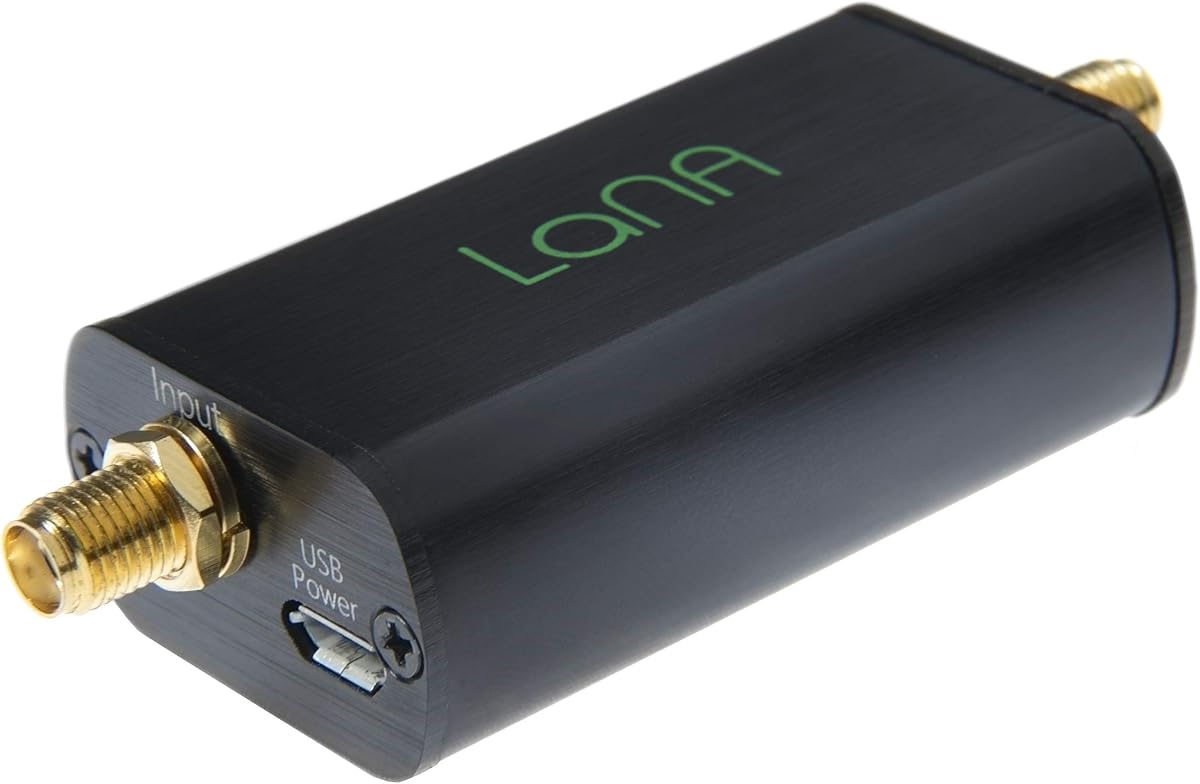
The Nooelec Lana is a high-performance general purpose LNA module designed to improve the SNR of your SDR setups. It offers wideband capability from 20MHz to 4GHz with an extremely low noise figure for better reception.
We may earn a commission when you buy through this link, at no additional cost to you.
Its design provides higher gain and lower noise figure compared to modules based on similar MMICs. It can be powered through a bias tee, USB, or DC power with the included adapter, offering flexibility in different environments.
While some SDRs may require a DC block between the LNA and receiver for external power options, its overall performance and linearity make it a great upgrade for RTL-SDR and other radios.
Ideal for enthusiasts looking to improve the performance of their SDR systems with a reliable and well-enclosed module.
Designed to improve the signal-to-noise ratio and performance of your SDR with extremely low noise figure.
Powered through bias tee, USB, or DC power with included adapter to fit your specific setup needs.
We may earn a commission when you buy through this link, at no additional cost to you.
The Generic Taurus MK2 Pre Amplifier is a new wideband unit perfect for any scanner receiver. With a frequency range of 25-2000 MHz, it covers a broad spectrum of signals suitable for various monitoring tasks.
We may earn a commission when you buy through this link, at no additional cost to you.
It offers a gain range of 6-20dB and runs on a standard PP3 battery for portable operation. The complete kit includes a BNC patch lead to ensure immediate setup with your existing equipment.
While it is designed primarily for scanners, its broad frequency coverage makes it a practical option for extending the range of compatible reception devices without complex wiring.
This is a straightforward choice for those seeking an affordable and simple signal booster for general scanning applications.
Perfect for any scanner receiver with a wideband pre-amplifier covering 25 to 2000 MHz frequencies.
Complete with BNC patch lead to ensure you have everything needed for immediate installation and setup.
We may earn a commission when you buy through this link, at no additional cost to you.
The BJ-300 Plus Broadband Linear Radio AMP supports multiple modulation modes including AM, FM, SSB, and CW. It delivers up to 100W for FM, 120W for AM, and 150W for SSB output power to extend your communication range.
We may earn a commission when you buy through this link, at no additional cost to you.
Equipped with a high-efficiency cooling fan and large aluminum heat sink, it ensures stable operation even during extended use. It includes electronic polarity reversal protection and dual fuses to safeguard against incorrect connections.
Although the rating is lower than others, it offers a compact and user-friendly design with standard PL-259 connectors for quick installation. It works with HF transceivers requiring low input power for versatile use.
This amplifier is suitable for users looking to extend communication range for reliable long-distance operation with basic safety features.
Delivers up to 100W FM, 120W AM, and 150W SSB output power for reliable long-distance operation.
Built with high-efficiency cooling fan and heat sink to prevent overheating during extended use.
We may earn a commission when you buy through this link, at no additional cost to you.
This AURSINC ZK09-UM LNA Module impresses with a 4.9 star rating and USB-powered convenience. It features an ultra-broadband frequency range of 100kHz-10GHz and a low noise design to suppress power-supply noise effectively.
We may earn a commission when you buy through this link, at no additional cost to you.
The built-in high-PSRR LDO provides obvious noise-floor improvement compared to regular USB powered modules. It is ideal as an external preamplifier for TinySA-ULTRA to improve high-band receiving and measuring performance.
Safety tips advise avoiding excessive input power to prevent saturation and keeping it in dry environments to avoid rust. Its compact shielded metal housing ensures stability and good flatness across the band.
Recommended for users needing a reliable external preamplifier with superior noise-floor improvement in portable setups.
USB-powered low noise pre-amplifier with on-chip bias solution allowing adjustment for different usage scenarios.
Built-in high-PSRR LDO suppresses power-supply noise for obvious improvement compared to regular modules.
We may earn a commission when you buy through this link, at no additional cost to you.
This variant of the BJ-300 Plus supports AM/FM/SSB/CW modes with output power up to 150W for SSB. It works with HF transceivers requiring low input power and includes high/low power selection switches for adjustable output strength.
We may earn a commission when you buy through this link, at no additional cost to you.
Built-in electronic switch and polarity inversion protection safeguard the amplifier from incorrect power connections. The compact aluminum alloy heat sink construction ensures efficient heat dissipation during operation.
Standard antenna and transceiver ports make installation quick and straightforward. While ratings are moderate, its protection features and durable design are valuable for basic station upgrades.
Suitable for users seeking a practical and durable amplifier for radio and HF transceiver applications.
Features HI/LO power selection switches to adjust output strength based on operating needs.
Built-in electronic switch and polarity inversion protection safeguard the amp from incorrect connections.
We may earn a commission when you buy through this link, at no additional cost to you.
The BJ-300 Broadband Linear AMP delivers up to 150W SSB output power ideal for radio and HF transceiver applications. It supports AM, FM, SSB, and CW modes with input power requirements of 3-5W for AM/FM.
We may earn a commission when you buy through this link, at no additional cost to you.
Features include an ON/OFF switch and LED indicator for easy use alongside an aluminum alloy heat sink for efficient heat dissipation. Overvoltage protection is built-in to ensure stable and safe operation.
Standard antenna and transceiver ports allow for quick installation without specialized tools. While no rating is currently listed, its durable construction suggests it is a reliable unit for practical use.
Recommended for users seeking a compact and durable amplifier with simple controls for HF frequency range use.
Delivers up to 100W FM, 120W AM, and 150W SSB output power for reliable signal amp.
Works with AM, FM, SSB, and CW modes ideal for radio and HF transceiver applications.
We may earn a commission when you buy through this link, at no additional cost to you.
Choosing the right amplifier involves balancing frequency range, power output, and noise performance to match your specific station setup and goals.
Ensure the amplifier supports the specific bands you use most often. Whether you need HF coverage or broader SDR ranges like 10MHz to 6GHz, matching the frequency range is critical.
Always verify the min and max frequencies in the product specifications before purchasing to avoid compatibility issues with your transceiver.
Gain measured in dB determines how much the signal is boosted. High-power amplifiers like 100W linear units are suitable for transmission while low-gain LNAs are best for receiving.
Match the output power to your needs; high wattage is useful for long-distance contacts while lower output is sufficient for local boosting.
A low noise figure ensures that weak signals are amplified without adding background interference. This is essential for clear reception especially when dealing with distant stations.
Look for amplifiers described with low noise or high linearity to maintain signal purity across different modulation modes.
Check if the amplifier needs a dedicated 13.8V source or can run on standard USB or battery power. Portable units offer flexibility while fixed units may provide more stable power.
Ensure your station power supply meets the amp requirements to prevent issues like overheating or failure during operation.
Advanced amplifiers include protections against overcurrent, overheating, and reverse polarity. These features extend the device lifespan and prevent damage from common setup mistakes.
Prioritize units with thermal management and electronic safeguards to ensure safe operation during long transmission sessions.
Confirm the amplifier uses connectors that match your existing cables. Common types include SMA, BNC, and PL-259 which vary by application and radio model.
Selecting the right connector type saves time and avoids the need for extra adapters that can introduce signal loss.
Robust metal enclosures help with heat dissipation and shielding. Compact designs are better for portable use while larger units may offer better thermal management for high power.
Consider how much space you have available and whether the build quality supports your typical operating environment like field vs fixed.
Look for units that are ready to use out of the box with included cables or adapters. Simple control interfaces make setup easier for all skill levels.
Check if any additional components are required and if the setup instructions are clear to streamline your experience.
Always connect the amplifier between your antenna and transceiver using high-quality coaxial cables. Proper grounding reduces interference and protects both your gear and equipment from electrical surges.
Monitor the temperature during extended use to prevent overheating especially with high-power units. Ensure adequate ventilation or cooling fans are working properly to maintain stable performance.
Regularly inspect connectors and cables for wear or damage that could degrade signal quality. Store portable units in dry and dust-free environments to prolong their life and functionality.
An LNA or Low Noise Amplifier is primarily used to boost receive signals with minimal noise added. A linear amplifier boosts transmit power significantly so it handles both transmission and reception depending on the design and specifications.
It depends on the model. Some units run on USB or standard 12V batteries while others require a dedicated 13.8V DC supply. Always check the product specs to confirm power requirements before setting up your station.
Identify the bands you use most often such as HF or VHF and look for amplifiers covering those ranges. If you use SDR or multiple modes, a wider broadband amplifier is usually more versatile.
Yes improper setup or excessive gain can lead to distortion or interference. Use amplifiers as recommended and avoid high power levels in noisy environments to maintain signal clarity.
A built-in cooling fan helps manage heat generated during high-power transmission. This prevents overheating and ensures consistent performance during extended operating sessions.
Portable amplifiers with battery options are ideal for field work where wall power is unavailable. They offer flexibility and ease of setup while delivering significant signal boosts.
This guide compared ten excellent amplifiers ranging from compact LNAs to powerful linear units. Each model offers unique strengths depending on your specific station needs and operating environment.
Prioritize features like frequency range and power output when selecting your next booster. Ensure you choose a unit that matches your transceiver capabilities for optimal performance.
Remember to check current availability and pricing before purchasing to secure the best value for your setup and budget.