
RC Cellmeter 7
4.7Editor score
Compact digital voltage checker
Works with LiPo and Li-ion cells
Displays individual cell voltage gaps
This guide compares the top Lithium Ion Battery Tester models for accuracy, compatibility, and features to help you find the right diagnostic tool for your
Finding the right diagnostic tool is essential for maintaining vehicle health. A reliable tester ensures your power source performs correctly under load and during everyday driving conditions.
We compared ten top-rated models based on accuracy, compatibility with different battery chemistries, and ease of use. Our analysis covers everything from basic voltage checks to advanced system diagnostics.
Each pick highlights specific strengths like portability or professional-grade features. Prices vary by model and retailer, so check current listings before purchasing to ensure you get the best deal.
4.7Editor score

4.5Editor score

4.5Editor score
This table provides a side-by-side view of all ten selected models. It highlights key specifications to help you quickly identify which tester matches your specific vehicle or application requirements.


The ANCEL BT410 stands out as a top-tier diagnostic tool for modern vehicles. It offers high accuracy and supports both traditional lead-acid and lithium-ion battery chemistries effectively.
We may earn a commission when you buy through this link, at no additional cost to you.
Its ability to provide clear health status and shareable QR reports makes it ideal for professional use or personal record keeping. The color screen ensures readability in various lighting conditions.
While it requires power from the battery being tested, this passive design eliminates the need for internal batteries. The price is higher than basic testers but reflects its advanced capabilities.
Drivers looking for a reliable all-in-one solution should consider this model. It simplifies complex diagnostics into simple actionable results for peace of mind.
This tester handles both 12V and 24V systems and works with lead-acid and lithium-ion batteries, making it versatile for modern vehicles.
The 2.4-inch color TFT screen with adjustable contrast ensures that test results are easy to read even in bright sunlight or dark garages.
We may earn a commission when you buy through this link, at no additional cost to you.
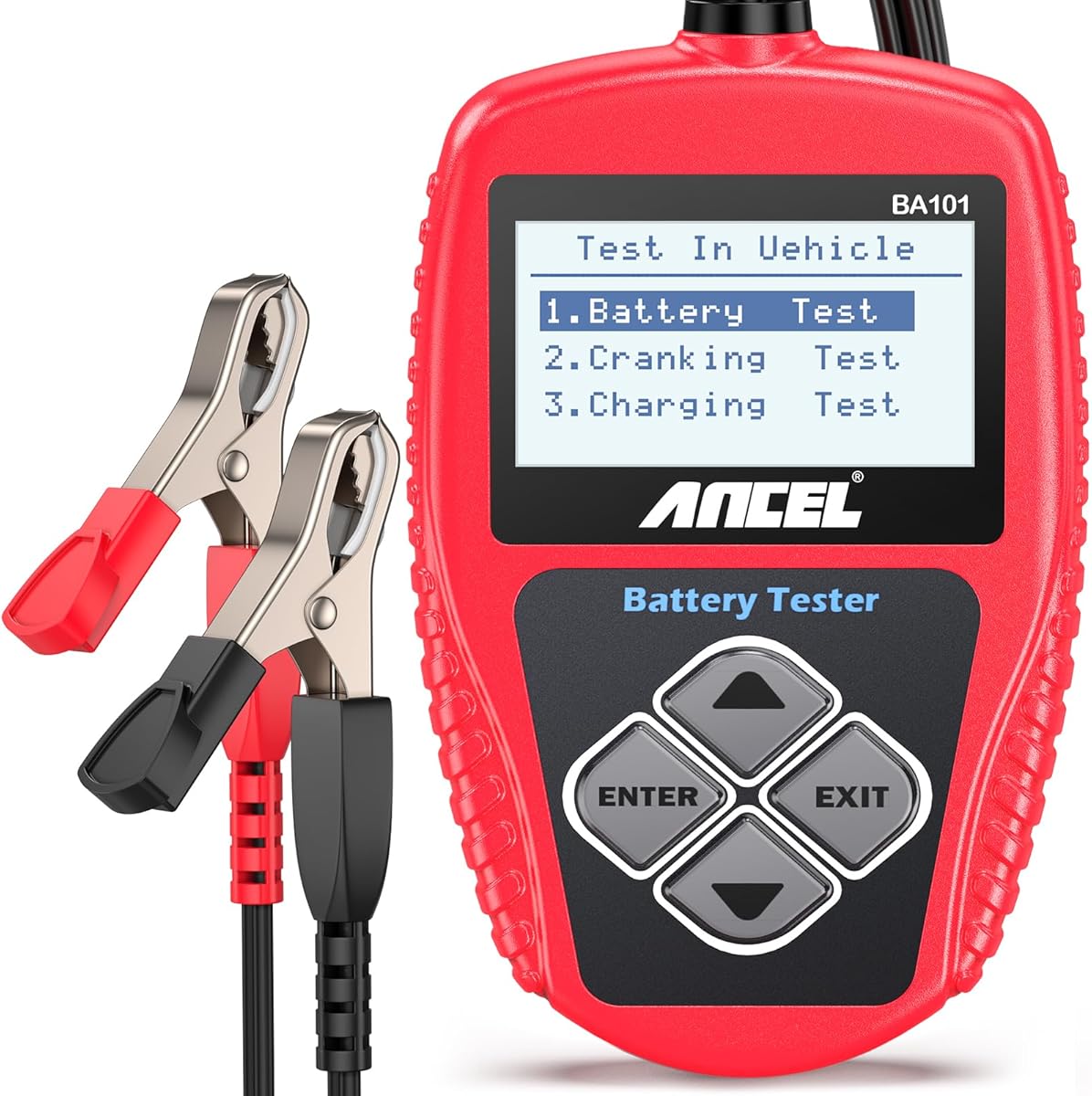
The ANCEL BA101 is a cost-effective solution for standard 12V vehicle maintenance. It provides essential health checks without the complexity of higher-end models.
We may earn a commission when you buy through this link, at no additional cost to you.
Its precision smart chip delivers dependable readings for state of health and charge. The design includes reinforced housing to withstand daily use in various environments.
Users should note it is strictly for lead-acid batteries. If you have a lithium system, this model will not provide accurate or safe results.
For budget-conscious DIYers with traditional vehicles, this tester offers excellent value. It balances functionality and simplicity for routine maintenance checks.
This tool provides easy-to-understand readings for state of health, state of charge, and voltage to help you avoid unexpected breakdowns.
Built-in four-in-one protection guards against reverse polarity and short circuits while the reinforced ABS housing adds extra durability for everyday use.
We may earn a commission when you buy through this link, at no additional cost to you.
This module is designed for testing small cylindrical lithium cells like 18650s. It measures capacity and internal resistance to help sort and verify battery packs.
We may earn a commission when you buy through this link, at no additional cost to you.
The four-channel support allows for simultaneous testing, which is efficient for hobbyists working on multiple cells. The display shows real-time voltage and current data clearly.
Setup requires following specific manual steps to access full functionality. It is not intended for vehicle batteries but excels at small-scale electronic projects.
Anyone building flashlights or custom packs will find this useful. It offers detailed technical data at a low cost for precise cell management.
The tester checks capacity, internal resistance, voltage, current, and power to provide comprehensive data for analyzing 18650 battery performance.
The integration of charge and discharge saves tedious operation of disassembling batteries when replacing equipment in your projects.
We may earn a commission when you buy through this link, at no additional cost to you.
The BT310 offers a smart balance of features for tracking battery health over time. Its ability to store previous reports helps users monitor degradation trends.
We may earn a commission when you buy through this link, at no additional cost to you.
It supports a wide range of battery standards and chemistries including lithium-ion. The five-way result system simplifies decisions on whether to replace or recharge.
The monochrome LCD is clear but lacks the color vividness of newer models. However, its functional design ensures reliable readings without unnecessary complexity.
Fleet owners or households with multiple vehicles will appreciate the data history. It turns one-time checks into a long-term health monitoring system.
The built-in Review Data function lets you retrieve previous reports for comparison to catch signs of a weakening battery before it becomes a problem.
It supports 12V and 24V systems plus six battery types including lithium-ion to cover a wide range of vehicles and applications.
We may earn a commission when you buy through this link, at no additional cost to you.
The TOPDON BT100 is ideal for those needing a portable solution. Its small size allows it to fit easily into a glove box for emergency checks.
We may earn a commission when you buy through this link, at no additional cost to you.
It performs three essential tests to determine overall health and system performance. The LED colors provide a quick visual reference for battery status without reading numbers.
Users should be aware it does not support lithium batteries. It is strictly designed for traditional 12V lead-acid systems in cars and trucks.
For casual users needing quick checks on standard vehicles, this is a strong pick. It combines portability with reliable performance for routine maintenance.
The tester is small and compact making it simple to keep in a glove box or center console for ready access whenever needed.
It uses a safe passive testing approach that ensures power is only on when properly attached to avoid accidental power draws.
We may earn a commission when you buy through this link, at no additional cost to you.
This device is a lightweight tool for checking voltage in RC batteries. It is perfect for hobbyists needing a quick check before a flight or drive.
We may earn a commission when you buy through this link, at no additional cost to you.
It displays total voltage and highlights gaps between cells which helps identify weak ones. The display mode is intuitive and provides instant feedback.
It is strictly for cells like LiPo or NiMH and not for vehicle systems. The build is simple but effective for its intended niche market.
Buyers needing a cheap voltage check for small packs will love this. It saves time and prevents damage from using weak cells.
This displays battery cell voltages total voltages and the gap between highest and lowest to ensure balanced packs.
Weighing only 45 grams this checker is simple and convenient to read and carry in any kit or pocket.
We may earn a commission when you buy through this link, at no additional cost to you.
The FOXWELL BT705 is designed for durability and professional use. Its long cable allows you to sit in the driver's seat while testing the battery under the hood.
We may earn a commission when you buy through this link, at no additional cost to you.
Step-by-step prompts on the screen guide you through testing reducing the learning curve for new users. The results are summarized clearly into simple actionable categories.
It is more expensive than basic tools but includes a protective case for transport. This makes it suitable for both shop use and serious home mechanics.
Anyone who values accuracy and ease of use will find this model rewarding. It bridges the gap between consumer tools and professional scanners.
The 5.9 ft test cable allows you to reach from the battery to the driver's seat to perform solo testing easily.
It features a protective housing durable clamps and an included hard carrying case to keep accessories organized and ready for repeated use.
We may earn a commission when you buy through this link, at no additional cost to you.
The BT705Plus is an enhanced version of the previous model with a powerful processor and color screen. It delivers results faster and offers a more vivid display for readings.
We may earn a commission when you buy through this link, at no additional cost to you.
Its high-conductivity clamps ensure accurate connections even on difficult terminals. The color LCD makes it easier to see details in various lighting conditions outdoors.
Despite the advanced features it remains limited to lead-acid batteries. Users with lithium vehicles will need to look at other models for full compatibility.
For those seeking the best in accuracy and speed this is a top choice. It combines professional features with user-friendly design for superior diagnostics.
Upgraded from the original it delivers results up to 30% faster with a more powerful processor and refined algorithms.
A high-contrast 2.8 inch color LCD ensures crisp visibility indoors or outdoors for easy reading.
We may earn a commission when you buy through this link, at no additional cost to you.
This universal tester is designed for common household batteries like AA and AAA. It uses a magnetic slot to secure the battery during testing for stability.
We may earn a commission when you buy through this link, at no additional cost to you.
The LCD shows voltage and health status clearly. It is rechargeable so you do not need to replace internal batteries regularly.
It is not built for automotive systems but works well for remotes and toys. The one-touch interface makes it very easy to use for anyone.
For maintaining everyday electronics this is a convenient tool. It ensures you always have working batteries ready when you need them.
Simply place the battery into the checker and slide the magnetic slider to secure it firmly without worrying about slipping.
The rechargeable unit offers a full charge that lasts up to 15 hours so you do not need frequent power changes.
We may earn a commission when you buy through this link, at no additional cost to you.
The La Crosse 911 is a straightforward tool for basic battery checks. Its pull tray mechanism ensures a good connection with the battery terminals easily.
We may earn a commission when you buy through this link, at no additional cost to you.
You select the voltage range manually and the LED shows the strength. It supports alkaline rechargeable and lithium button cells for variety.
It does not offer detailed analysis like professional automotive testers. It is a quick and cheap way to sort old from new batteries.
For home users with many small batteries this is perfect. It prevents frustration by identifying weak cells before use.
Simple operation in 3 easy steps involves selecting range inserting the battery and sliding the tray closed for connection.
It supports 1.5V for alkaline 1.2V for rechargeable and 3V for lithium button cell batteries.
We may earn a commission when you buy through this link, at no additional cost to you.
Selecting the right tester depends on your vehicle type and the data you need. This guide outlines key factors to help you make an informed choice.
Ensure the tester supports the specific chemistry of your battery. Many automotive testers only check lead-acid batteries while others explicitly support lithium-ion systems.
Always verify if the model mentions lithium compatibility before purchasing to avoid inaccurate results.
Check whether the tester handles 12V, 24V, or both. Most passenger vehicles use 12V but trucks and heavy equipment often require 24V support.
Select a model that covers your vehicle's electrical system to ensure safe and accurate testing.
Consider how much data you want to see. Basic models show voltage while advanced ones provide state of health cranking data and alternator ripple checks.
Choose a tester that offers the level of detail needed for your specific maintenance goals.
A clear display is essential for reading results in garages or sunlight. Color screens are easier on the eyes than monochrome LCDs.
Look for adjustable contrast and backlighting to ensure you can read data in any environment.
Built-in protections against reverse polarity and short circuits prevent accidental damage to your battery or tester. These features are vital for non-experts.
Prioritize models that mention safety shields to protect your vehicle's electrical system during testing.
User-friendly interfaces with clear prompts or simple menus reduce errors. Some models provide one-way results like REPLACE or RECHARGE instead of raw numbers.
Look for testers with straightforward steps to simplify the diagnostic process for all users.
Longer cables allow you to reach batteries in tight engine bays. Sturdy clamps ensure a solid connection and prevent slipping during tests.
Check specifications for cable length and clamp material to ensure they match your vehicle's layout.
Advanced models allow you to store test history to track battery degradation over time. This is useful for monitoring multiple vehicles or long-term health.
Consider if you need to save reports or QR codes for future reference when choosing a model.
Always clean the battery terminals before attaching the clamps to ensure a solid connection. Dirt or corrosion can lead to inaccurate readings during the test process.
Follow the manual's instructions for selecting the correct battery type and rating. Entering the wrong value can confuse the tester and provide misleading results.
Store the device in a cool dry place when not in use to preserve its internal electronics. Avoid dropping the tester or subjecting it to extreme temperatures.
Not always. Many standard automotive testers are designed for lead-acid chemistry. You must ensure the model explicitly supports lithium-ion to avoid inaccurate readings or damage.
CCA stands for Cold Cranking Amps and measures how well a battery starts an engine in cold weather. Entering the correct CCA rating helps the tester provide accurate health assessments.
Most automotive testers draw power directly from the battery being tested. This passive design means you do not need internal batteries or external chargers for operation.
Testing every six months is recommended to catch issues before they lead to breakdowns. More frequent checks are wise if you notice slow starts or electrical flickering.
A low SOH indicates the battery has lost capacity over time. It suggests the battery may need replacement even if it still holds a charge.
Higher-end models often include features like color screens data storage and broader compatibility. They also tend to have better build quality and longer warranties.
Many advanced testers include a charging system test to check alternator output. This helps you determine if the battery is weak or the charging system is failing.
Some models support running engine tests to check alternator health. Always follow the specific instructions for your tester to avoid short circuits or electrical shock.
Choosing the right tool ensures your vehicle starts reliably. Whether you pick the ANCEL BT410 for its broad compatibility or the RC Cellmeter for hobby use find the model that fits your needs.
Prioritize features like lithium support and clear displays for accurate diagnostics. Investing in quality hardware now can save money on unnecessary replacements later.
Prices vary based on features and retailers so verify current listings before buying. Always double-check specifications to confirm compatibility with your specific battery type.